
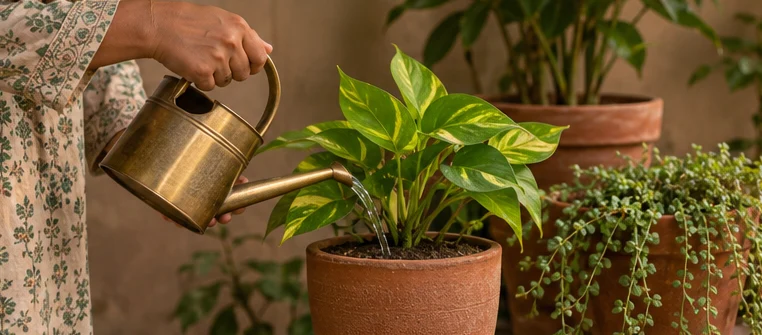
A good container mix gives roots air, drains excess water and holds the amount of moisture your plant needs.
Choose by plant type
For many foliage plants, start with an airy container mix containing a moisture-holding ingredient such as coir and an aerating ingredient such as perlite or bark. Succulents often need a faster-draining mix with more mineral material. Many common epiphytic orchids suit a coarse orchid bark mix.
Pair the mix with the right pot
Use a container with open drainage holes. When moving a root-bound plant up a size, choose a pot only modestly wider than its root ball. A large volume of unused mix can hold water longer than the roots need.
Check how it behaves after watering
Water should penetrate the root ball and flow out below. If it pools on top or the mix stays wet much longer than expected, check the drainage holes and whether the mix has compacted. Heavy garden soil can compact in containers.
Repot when there is a reason
Crowded roots, decomposed mix or poor drainage can warrant repotting. Handle roots gently and keep the stem at its previous depth unless the species needs a different approach. Recheck the watering interval after repotting.
Pick different mixes for pothos and succulents
A pothos can suit a mix that stays lightly moist while allowing air around the roots. A succulent usually needs a mix that dries faster, especially indoors. Before repotting, check the old root ball. A plant with healthy roots and a mix that drains well may still have room to grow.
Frequently Asked Questions
Can I use garden soil in a pot?
Garden soil often compacts in a container. A mix formulated for pots generally allows better airflow and drainage.
Do stones at the bottom improve pot drainage?
Use open drainage holes and a suitable mix throughout the pot. A gravel layer takes up root space and can leave wet mix sitting above the gravel.